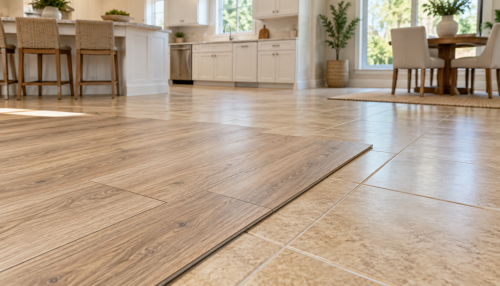
If you're remodeling a kitchen, bathroom, laundry room, or basement in Southlake, Westlake, Colleyville, Grapevine, or anywhere in the DFW metroplex, waterproof flooring is one of the smartest upgrades you can make in 2026. Texas summers bring extreme heat, sudden storms, and high indoor humidity — and that combination can be brutal on traditional hardwood. The good news? Today's waterproof floors look better than ever, and three options dominate the market: SPC, WPC, and Luxury Vinyl Plank (LVP).
This guide breaks down the differences so you can choose the right floor for your home, your lifestyle, and your budget.
What Does "Waterproof Flooring" Actually Mean?
A truly waterproof floor is one whose core and surface will not swell, warp, or delaminate when exposed to liquid water for an extended period. That's different from "water-resistant" floors (like engineered hardwood or laminate), which can handle spills but not standing water. In a Texas home — where a dishwasher leak, an ice-maker line, or a humid mudroom is just a Tuesday — a fully waterproof core is a serious advantage.
SPC Flooring (Stone Plastic Composite)
SPC is the rigid-core powerhouse of the vinyl world. Its core is made from limestone powder and PVC, giving it the density of stone and the resilience of plastic.
Pros of SPC
- 100% waterproof — perfect for bathrooms, kitchens, and basements
- Extremely dent-resistant — handles heavy furniture, kids, and pets
- Dimensionally stable — barely expands or contracts in Texas heat
- Floats over almost any subfloor, including existing tile
Cons of SPC
- Harder underfoot than WPC (though most planks include an attached underlayment)
- Slightly louder without a quality pad
WPC Flooring (Wood Plastic Composite)
WPC swaps the stone powder for a wood-fiber-and-foam core, producing a softer, warmer plank.
Pros of WPC
- Softer and quieter underfoot — great for bedrooms and living rooms
- Warmer in winter, comfortable on bare feet
- Still 100% waterproof
Cons of WPC
- Less dent-resistant than SPC under heavy point loads
- Thicker planks may require door undercutting
- Typically priced slightly higher than comparable SPC
Luxury Vinyl Plank (LVP)
LVP is the umbrella category — SPC and WPC are both technically rigid-core LVP. When people say "LVP," however, they usually mean the flexible, glue-down or click-lock vinyl that's thinner and more affordable.
Pros of LVP
- The most budget-friendly waterproof option
- Massive design selection — realistic wood, stone, and tile visuals
- Comfortable underfoot and easy to repair plank-by-plank
Cons of LVP
- Flexible cores telegraph subfloor imperfections — prep matters
- Less impact-resistant than SPC
- Glue-down versions need a very flat, clean subfloor
SPC vs WPC vs LVP: Quick Comparison
| Feature | SPC | WPC | Flexible LVP |
|---|---|---|---|
| Waterproof | Yes | Yes | Yes |
| Dent resistance | Excellent | Good | Fair |
| Comfort underfoot | Firm | Soft | Soft |
| Heat stability (Texas summers) | Best | Good | Moderate |
| Typical installed cost (DFW, 2026) | $6–$10/sq ft | $7–$11/sq ft | $4–$7/sq ft |
Which Waterproof Floor Is Best for Texas Homes?
For most Southlake and DFW homeowners, SPC is the safest all-around pick. Our climate swings between 100°F+ summers and chilly winter cold fronts, and SPC's stone core shrugs off thermal movement that can buckle softer floors. If you have a young family or large dogs, the dent resistance is a real, day-to-day benefit.
Choose WPC if comfort and warmth matter most — bedrooms, second floors, or anywhere you walk barefoot regularly.
Choose flexible LVP when you need a budget-friendly waterproof refresh for a rental, a starter home, or a basement remodel.
Installation Tips Specific to North Texas
- Acclimate planks for 48 hours in the room where they'll be installed — Texas humidity fluctuations are real.
- Don't skip the moisture test on concrete slabs, especially in slab-on-grade DFW homes.
- Use proper expansion gaps around walls and fixed objects; SPC moves less, but it still moves.
- Choose a quality underlayment if your planks don't have one attached — it dramatically improves sound and comfort.
How Long Does Waterproof Flooring Last?
A professionally installed SPC or WPC floor in a Southlake home typically lasts 20 to 30 years, with surface wear layers (usually 12 to 22 mil) being the main factor in long-term durability. Most premium products carry residential lifetime warranties.
Ready to Upgrade Your Floors in Southlake?
At Southlake Floors, we install SPC, WPC, and luxury vinyl plank in homes across Southlake, Westlake, Colleyville, Trophy Club, Grapevine, Keller, and the entire DFW metroplex. We bring samples to your home, match the right product to your subfloor and lifestyle, and back every job with our local craftsmanship guarantee.
Get your free in-home flooring estimate today — or browse our recent flooring projects for inspiration.