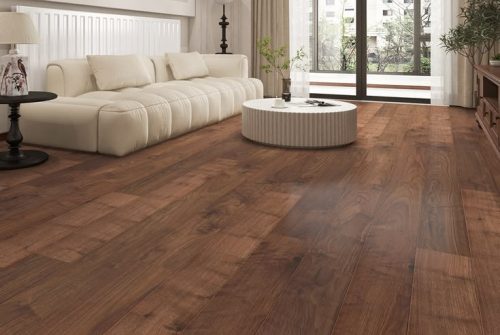
If you're shopping for hardwood floors in Dallas–Fort Worth, the first question every installer will ask is: engineered or solid? Most DFW homeowners hear "engineered" and assume it's cheap, plywood-looking flooring. It's not. Modern engineered hardwood has a real sawn-wood top layer that's indistinguishable from solid — and in Texas's climate, it often performs better. Here's the honest comparison.
The short answer
For most DFW homes built on a concrete slab (which is 80%+ of homes built in the last 30 years across Southlake, Frisco, Plano, and Dallas suburbs), engineered hardwood is the right choice. For older homes with plywood subfloors in Fort Worth's historic districts, M-Streets Dallas, or Lakewood — solid hardwood still wins.
What's actually different between them?
Solid hardwood is exactly what it sounds like: one piece of wood, typically ¾" thick, milled from a single board. You can sand and refinish it 6–10 times over its life.
Engineered hardwood is a real wood top layer (called the wear layer, 2–6mm thick) bonded to a multi-ply plywood or HDF core. The wear layer is genuine sawn wood — oak, walnut, hickory, maple — so the surface looks and feels identical to solid. Quality engineered floors can be sanded 2–4 times depending on wear-layer thickness.
1. Climate stability — engineered wins in DFW
Texas humidity swings hard. Outdoor summer humidity hits 70–80%, indoor winter humidity drops to 25% with heaters running. Wood is hygroscopic — it absorbs moisture and expands, releases it and shrinks. That movement is what causes hardwood floors to cup, gap, crack, or buckle.
Solid hardwood expands and contracts as a single piece. A 6" wide solid plank can move ⅛" between summer and winter — multiply that across an open-concept living room and you get visible gaps.
Engineered hardwood's multi-ply core counteracts the movement (the plies run perpendicular to each other, locking each other in place). A 6" engineered plank moves less than 1/32" across the same humidity swing. That's why every reputable wide-plank (>5") install in DFW is engineered, not solid.
2. Subfloor compatibility — engineered wins on slabs
Solid hardwood requires a wood subfloor — typically ¾" plywood — because it needs to be nailed or stapled down. You cannot install solid hardwood directly on a concrete slab without first installing a floating plywood subfloor (which adds $4–$7 per sq ft and ¾" of height).
Engineered hardwood installs three ways on slabs: glue-down (most secure), floating over underlayment (fastest), or nail-down to a plywood subfloor. This flexibility is why nearly every DFW custom home built since 2000 uses engineered.
3. Cost comparison — engineered is cheaper installed
Material cost is similar — both run $4–$10 per sq ft for the wood itself depending on species and quality. The big difference is installation:
- Solid on plywood subfloor: $4–$7 per sq ft labor
- Solid on slab (requires floating plywood): $8–$11 per sq ft labor
- Engineered glue-down on slab: $3–$5 per sq ft labor
- Engineered floating install: $2–$4 per sq ft labor
For a 1,500 sq ft home on a slab, engineered saves $5,000–$10,000 installed.
4. Refinishing — solid wins long-term
This is where solid hardwood earns its premium. A ¾" solid floor can be sanded down 6–10 times — meaning it can last 75–100+ years with refinishing. Many DFW homes still have original red oak from the 1940s under their carpet.
Engineered hardwood with a thick wear layer (3mm+) can be sanded 2–4 times — still 30–50 years of life. Engineered with a thin wear layer (1–2mm) can only be screened-and-recoated, not fully sanded — 15–25 year lifespan.
For DFW homeowners planning to stay 20+ years and refinish multiple times, solid still makes sense in homes where it can be installed properly.
5. Look and feel — identical
Walk into any high-end DFW home built in the last decade and you cannot tell the difference between solid and engineered hardwood by looking at it. The wear layer is real wood — same grain, same stain, same finish, same texture. Cheap engineered (with thin or printed top layers) is identifiable instantly. Quality engineered is indistinguishable.
The one tell: edge profile. Solid usually has a square or microbeveled edge. Engineered often has slightly more pronounced beveling. In wide-plank engineered, beveling is intentional and adds character.
6. Width and length — engineered wins for wide planks
Modern luxury hardwood trends toward wide planks: 7"–10" widths, 6'–12' lengths. Solid hardwood at these widths is unstable in Texas humidity — it'll cup or crack within two years. Engineered handles wide planks beautifully because the cross-ply core prevents movement.
Almost every wide-plank hardwood install in Southlake luxury homes, Frisco custom builds, Westover Hills estates, and Highland Park renovations is engineered for this exact reason.
7. Resale value — both add value, similarly
Real-estate appraisers in DFW value "hardwood floors" — most don't differentiate between solid and engineered if the surface looks like real wood. The National Association of Realtors estimates hardwood floors recover 106% of installed cost at resale — meaning hardwood actually adds more to the home's value than it costs to install.
When to choose solid hardwood
- Your home has a plywood subfloor (older Dallas/Fort Worth properties, second floors of newer homes)
- You want narrow planks (2¼"–4")
- You plan to refinish multiple times (20+ year ownership)
- You're matching existing solid hardwood
- You're in a historic home and want period-correct flooring
When to choose engineered hardwood
- Your home is on a concrete slab (most DFW homes)
- You want wide planks (5"+ widths)
- You're installing in a kitchen, basement, or below-grade room
- You want a faster, cheaper installation
- You live in a climate-controlled home with reasonable humidity
What about engineered "click-lock" floating floors?
The popular RevWood, Pergo Outlast, and Mohawk floating engineered floors are halfway between traditional engineered and LVP. They're fine for budget remodels and rental properties, but they don't feel as solid underfoot as glue-down engineered, and they have shorter refinishing life. For a forever-home install, choose traditional engineered glue-down.
Bottom line for DFW homeowners
If you're on a slab and want wide planks (which is what nearly every modern DFW home wants): engineered, glue-down, with a 3mm+ wear layer. Brands to ask about: Mirage, Lauzon, Mercier, Hallmark, Provenza, DuChâteau.
If you have a plywood subfloor and want a 50-year floor: solid hardwood, nail-down install, ¾" thickness. Brands: Bruce, Somerset, Carlisle, Mohawk.
Both can look identical when finished. Both add value. The right choice depends on your subfloor, your plank width preference, and how long you plan to own the home.
Browse our hardwood installation services or request a free in-home estimate — we'll measure, check your subfloor, and recommend solid or engineered based on your specific home.