If you're shopping for new flooring in the Dallas–Fort Worth area, you're solving a problem most online guides don't actually understand: Texas climate is hard on floors. Summers hit 100°F+ with 60–80% outdoor humidity. Winters drop indoor humidity below 30% with the heater running. And the entire region sits on expansive clay that swells and shrinks under your foundation every year.
Pick the wrong flooring and you'll be living with cupping boards, cracked grout lines, peaking hardwood seams, and gaps wide enough to lose a quarter into within 24 months. Pick the right one and your floor will outlast the next two roof replacements.
This guide is what we tell our actual clients in Southlake, Keller, Frisco, and Fort Worth — no manufacturer fluff, no Pinterest aesthetics, just what holds up.
What "Texas-tough" actually means
Three forces destroy flooring in DFW homes:
- Humidity swing: Indoor humidity in a typical Plano home moves between 28% (Jan) and 65% (Aug). Wood expands and contracts roughly 0.25% per 1% moisture change. Across a 12" hardwood board, that's real movement.
- Foundation movement: Slab-on-grade foundations on expansive clay can shift 1/4"–3/4" between wet and dry seasons. Rigid floors crack at the grout joints; flexible floors absorb the movement.
- Surface heat: A south-facing tile floor in a 110°F July afternoon can hit 95°F surface temperature. Some adhesives soften, some vinyl adhesives release.
Hardwood: works, but only the right way
Solid hardwood gets blamed unfairly in DFW. The truth: it works if you install it correctly. Here's the 4-rule playbook we follow:
- Engineered, not solid, in any room over a slab. Engineered hardwood is dimensionally stable across humidity swings. Solid 3/4" oak over a slab in DFW will gap in winter every year of its life.
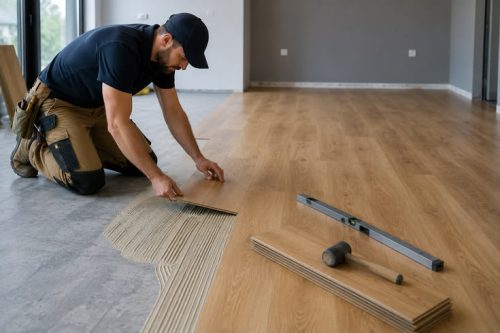
- Acclimate 48–72 hours on-site. Material delivered Monday should not be nailed down Monday afternoon. The boxes need to sit unwrapped in the actual rooms they're going in.
- Run the HVAC at install conditions. If the homeowner keeps the house at 72°F and 45% humidity year-round, we acclimate to those numbers — not whatever the construction site is doing.
- Whole-home humidifier for any wide-plank install. Above 5" plank width, the cost-benefit math on a $1,200 humidifier vs. floor warranty risk is a no-brainer.
Best DFW hardwood picks: Mirage Maple, Bruce Engineered American Originals, Mannington Antique Lock&Fold, and Shaw Floors Castlewood. Avoid budget Chinese-made engineered with thin (under 2mm) wear layers — they cup within 18 months in this climate.
Luxury Vinyl Plank (LVP): the DFW favorite
For most DFW homeowners, LVP is the answer. We install more LVP than any other product because it solves all three Texas problems:
- Waterproof: Doesn't care about a hot-tub leak, a sweating glass, or a pet accident.
- Dimensionally stable: WPC and SPC cores barely move with humidity changes.
- Forgiving over imperfect subfloors: The right underlayment hides 1/8" of slab variance — common in 20-year-old DFW homes with foundation movement.
The catch: not all LVP is equal. Wear layer is the single most important spec. Below 12 mil, expect dents. 20-mil products handle homes with kids, dogs, and dropped tools. Brands we trust: COREtec Pro Plus, Shaw Floorté Pro, Mannington Adura Max, and Karndean Korlok.
Tile & porcelain: bulletproof, with one weakness
Porcelain tile is the most durable floor you can buy. It doesn't care about humidity, water, or heat. The weakness in DFW is the same as anywhere: your subfloor.
If your foundation moves and you have rigid 24×24 porcelain tile glued to the slab, the grout cracks. Then the tile cracks. We solve this by installing uncoupling membrane (Schluter DITRA or USG Durock) under any tile in DFW — it costs an extra $1.50/sq ft and prevents grout-line cracking from foundation shift.
Best DFW tile choices:
- Wood-look porcelain plank: Look of hardwood, performance of tile. Daltile Emerson Wood, Florida Tile Berkshire.
- Large-format 24×24 or 24×48: Fewer grout lines = less maintenance and more visual flow in open-concept layouts.
- Epoxy grout: DFW tap water is hard (130–180 ppm). Cement grout stains; epoxy grout doesn't.
Laminate: budget option that earns its keep
Modern laminate (since ~2018) is dramatically better than the click-floor your parents had. Top-tier laminate from Pergo TimberCraft or Mohawk RevWood Plus is genuinely waterproof, scratch-resistant, and indistinguishable from hardwood at 6 feet.
The right use case: budget-conscious bedrooms, rental properties, or kids' rooms where you want hardwood looks at half the price. Skip cheap laminate — wear layer thickness matters more than finish style.
What we don't install in DFW homes anymore
- Solid hardwood over a slab. Always engineered.
- Bamboo. Cups in DFW humidity swings within 3–5 years, every time.
- Cork. Sun-fades in south-facing rooms; stains too easily.
- Sheet vinyl over uneven subfloors. Telegraphs every imperfection. Switch to LVP click-lock.
The 30-second decision matrix
| If you have… | Pick |
|---|---|
| Kids + pets + open kitchen | LVP, 20-mil wear layer |
| Luxury custom home, formal living | Wide-plank engineered hardwood |
| Bathroom or laundry | Porcelain tile w/ uncoupling membrane |
| Rental or budget remodel | Premium laminate (Pergo, Mohawk RevWood) |
| Whole-house consistency | Wood-look porcelain plank |
Ready to pick your floor?
Every DFW home is different — the floor that's perfect for a 1995 Keller two-story is wrong for a 2018 Southlake luxury custom. The fastest way to a confident decision is a free in-home consultation — we measure, check your subfloor and humidity, walk through samples in your actual lighting, and give you a fixed-price quote on the spot.